So, have you ever been in a barber supply store looking at a pair of patterned scissors that cost between $300 to $700? If so, then you have probably asked the same question that every other barber or barber professional has asked:
Are Damascus shears worth it?
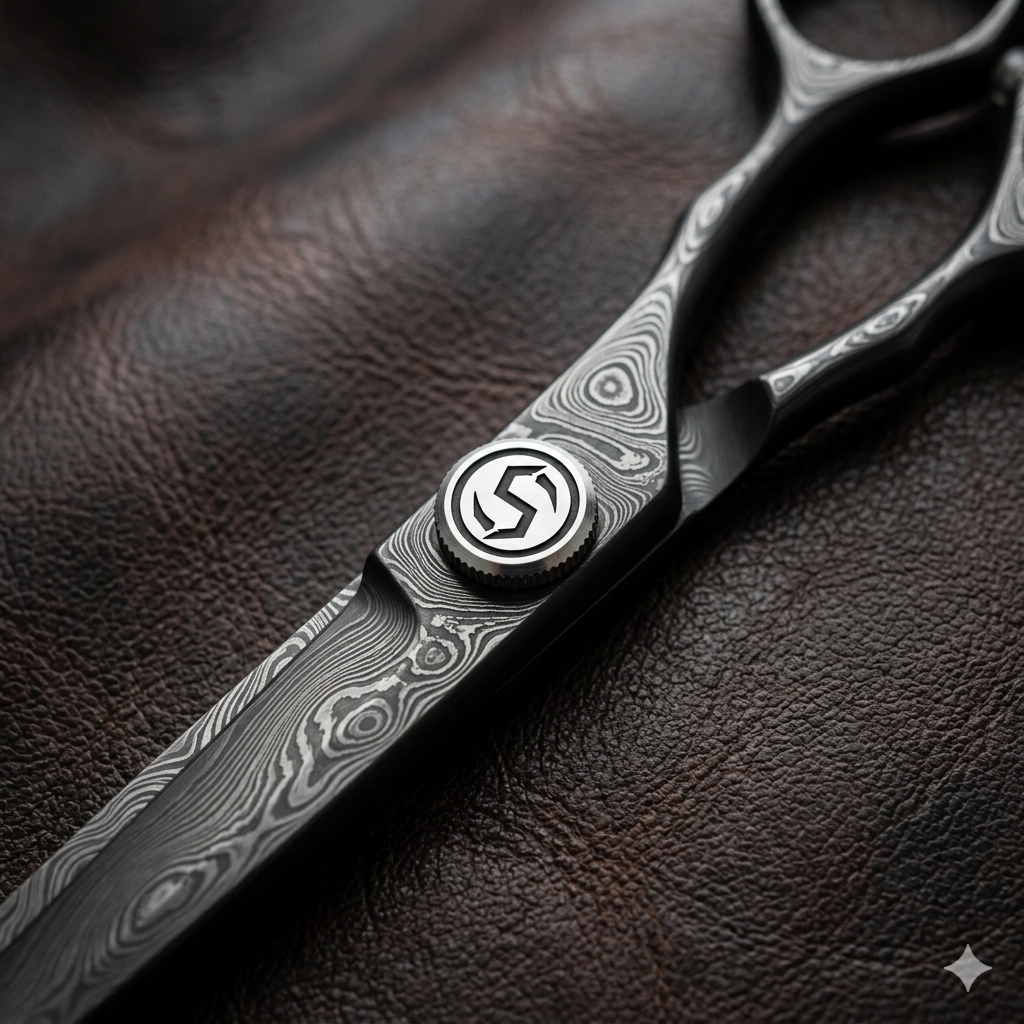
Well, the answer to this question is a fair one. So, let’s be honest about the answer. For a barber who works with 15 to 25 customers a day, tools matter. Edge retention matters. Balance matters. And if you are looking to upgrade from standard 440C stainless steel shears, then you want to know if Damascus steel shears are worth the investment. So, are Damascus shears for barbers really worth the investment? Let’s dive in to find out. For a deeper technical explanation of Damascus steel construction, feel free to check out our article on Damascus hair shears – the complete professional guide on this site. What Does Damascus Steel Mean for Barber Hair Shears? When a barber first looks at a pair of Damascus steel hair scissors, the first thing that catches their eye is the patterned edge. So, what does this mean? Well, the flowing patterns are a result of a construction technique where layers of steel are folded and stacked. This results in a strong yet flexible edge. Damascus steel was originally used to make samurai swords because of this. Barber shears work the same principle.
Most professional quality Damascus shears have a three-part structure:
- Hard cutting core steel
- Softer stainless steel on the outside
- A forged layered construction where you see the Damascus pattern
This is where the number of layers in a Damascus shear comes into play.
How Many Layers Do Damascus Shears Actually Have?
A question many barbers ask is how many layers Damascus shears have.
Professional quality Damascus shears are
- 67 layers (entry-level professional quality Damascus)
- 100-150 layers (mid-range professional quality Damascus)
- 300+ layers (hand-forged Japanese quality Damascus)
This increases stress distribution in the blade so it’s less likely to micro-crack during heavy use. However, this is not where quality is determined; it’s not even close.
What You’re Actually Paying For
A $500 pair of Damascus shears is not just a pretty face; there are a number of factors in play here.
- Steel Composition
The biggest factor in a $500 pair of Damascus shears is the following:
- High-end quality VG10 composition in a pair of Damascus shears
- VG10 is a high-carbon stainless steel composition commonly found in high-end quality Japanese Damascus shears.
Typical composition:
- VG10 core composition
- 60-61 HRC hardness rating on the cutting edge
- Excellent corrosion resistance
- Exceptional quality Damascus shear edge retention
Some high-end quality shears may even go a step further:
- ATS-314 composition in a pair of high-end quality Damascus shears
- ATS-314 composition is another high-end quality composition commonly found in high-end quality professional shears.
Typical composition:
ATS-314 composition
62-63 HRC hardness rating
This gives it slightly stronger edge retention than VG10 composition.
The outer Damascus layers, which are normally made of stainless steel such as 410 steel, are normally softer, with a rating of HRC 52-56. This provides impact absorption while protecting the cutting edge.
Therefore, when the question of Damascus shears HRC ratings is asked by the average barber, the answer will be as follows:
For quality shears:
HRC 60-63 at the cutting edge.
- Forging and Layering
True Damascus shears are forged through a layering and forging process that takes significantly longer to produce than regular stainless steel shears.
The layers of steel are:
- Stacked
- Heated
- Folded
- Forged Together
- Repeated to form the final product
Many high-quality shears are hand-forged barber shears, especially those made in Japan.
- Craftsmanship
Craftsmanship goes a long way in high-end shears.
The standard for quality shears is normally Japanese Damascus shears. This is because they offer the best grinding, heat treatment, and balance.
After the forging of the shears, the blade edge is ground to a convex edge Damascus shears. This is the most popular edge for professional barbers.
The convex edge provides the following:
Smooth cutting action
Less resistance while cutting
Clean slide cutting and point cutting
This is the main reason why professional barbers will normally feel a difference the moment they pick up a pair of convex edge shears as opposed to beveled edge shears.
Damascus Shears vs 440C – Which One Is Better for Barbers?
The most commonly asked question online is Damascus shears vs 440C which one is better for the average barber.
The answer to this question will depend on what the average barber is looking to get from the shears.
440C Steel Shears
440C has been the standard for years. Many professional barbers still use this every day.
Pros:
- Strong corrosion resistance
- Durable and affordable
- Easy to maintain
- Good performance for daily cutting
Cons:
- Edge retention slightly lower than the best steels available
- Sharpening required more often
Damascus Steel Shears
Pros:
- Often made from good quality VG10 or ATS 314 core steel
- Better edge retention for damascus steel shears
- Extremely smooth convex cutting action
- Unique craftsmanship
Cons:
- Generally more expensive
- Needs to be sharpened by an expert
- Some damascus steel shears are fake
Damascus Barber Shears Review: Pros and Cons for Professionals
Now let’s discuss the real-life benefits and drawbacks.
Pros
- Longer edge retention
- A Damascus steel shear cutting 15 clients per day will last 900 to 1100 cuts before sharpening. That is equivalent to 8 to 10 weeks of cutting in a busy environment.
- Smoother cutting action
- Convex cutting is much smoother than the cutting action of a beveled edge.
- Better fatigue reduction
- A well-balanced damascus steel shear will make cutting much easier for long periods of time.
- Craftsmanship
- Many professional barbers will admit to enjoying the feel of a well-made product.
Cons
- Generally more expensive
- A good damascus steel shear will start at 300 dollars and go up to 700 dollars or more.
- Needs to be sharpened by an expert
- Not all sharpeners have the expertise to sharpen Damascus steel shears.
- Some damascus steel shears are fake
- Some Damascus steel shears will have fake Damascus steel designs. These Damascus steel shears will have none of the structural benefits of real Damascus steel.
If you want to learn how to identify them, check out our article on how to identify fake damascus steel shears.
Damascus Shears Maintenance Guide
Are Damascus shears Barbicide safe?
Damascus shears are Barbicide safe when used properly.
Recommended Best Practices
- Soak for less than 10 minutes
- Rinse immediately
- Dry thoroughly
- Apply a drop of shear oil
Leaving any shear soaking for an extended period can damage the edge.
Damascus Shear Sharpening
Damascus Shears sharpening depends on their use.
If you are a barber cutting 15 people per day, a VG10 Damascus Shear needs to be sharpened every:
- 900 to 1,100 cuts or every 8 to 10 weeks.
It is recommended that you get your Damascus Shears sharpened by a professional with experience sharpening convex edges with layered steel. This is because a normal belt grinder user can damage the edge.
Recommended Reading
For a full article on how to properly maintain your Damascus Shears, see our full article on Damascus Shears Maintenance.
Who Should Buy Damascus Shears
Damascus Shears make sense for:
- Full-time barbers
- Professionals cutting 15 to 25 people per day
- Upgrading from 440C
- Professionals who demand the best
If you fall within the above category, then Damascus Shears for barbers can be a great investment.
Are Damascus Shears Good for Beginners?
Short answer: no.
Damascus Shears for beginners rarely make sense because:
- Beginners won’t notice performance differences
- It’s more expensive
Maintenance and sharpening are more specialized
It is better for new barbers to hone their skills with top-quality 440C steel first.
Our Recommendation
If you are a professional barber with 15+ clients per day and want to find the best Damascus barber shears available, here is what we recommend:
Steel type: VG10
Hardness: 61 HRC
Number of layers: 67
Edge type: Convex
Price range: $400-$600
This is the best combination of durability, edge retention, and actual Damascus steel.
Once our shop is more established, we will release an official ranking of the best Damascus barber shears available.
Are Damascus Shears Worth It?
So, with all the above factors considered, are Damascus barber shears worth the investment?
To some professional barbers, yes.
If you are a barber with 15+ clients per day and want the best shears with an edge retention that can last you a long time, then yes, they are worth the investment.
However, they are not magical.
Any barber with decent 440C steel can get the exact same results.
Damascus barber shears are really about the level of detail and craftsmanship they offer.
If you value those things, then yes, they are worth the investment.
FAQs
Are Damascus shears worth $500 for a working barber?
For a full-time barber doing 15+ clients per day, yes — provided the shear uses VG10 or ATS-314 core steel with genuine Damascus construction. The performance improvement over 440C is subtle but noticeable: smoother cuts, longer edge retention, and slightly reduced hand fatigue during long cutting sessions.
Do Damascus shears last longer?
In terms of edge retention, yes. A VG10 Damascus shear typically lasts 900–1,100 cuts between sharpening cycles, compared with shorter cycles for standard 440C shears. Durability also depends on proper maintenance and sharpening technique.
Are cheap Damascus shears real?
Usually not. Genuine Damascus shears require extensive forging and cannot realistically be produced under $200 at professional quality. Most sub-$100 options are acid-etched stainless steel designed to mimic Damascus patterns.
How many layers do real Damascus shears have?
Real Damascus shears typically range from 67 layers to over 300 layers. Entry-level professional models usually start at 67 layers, while high-end Japanese Damascus shears can exceed 300 layers depending on the forging process.
Leave a Reply