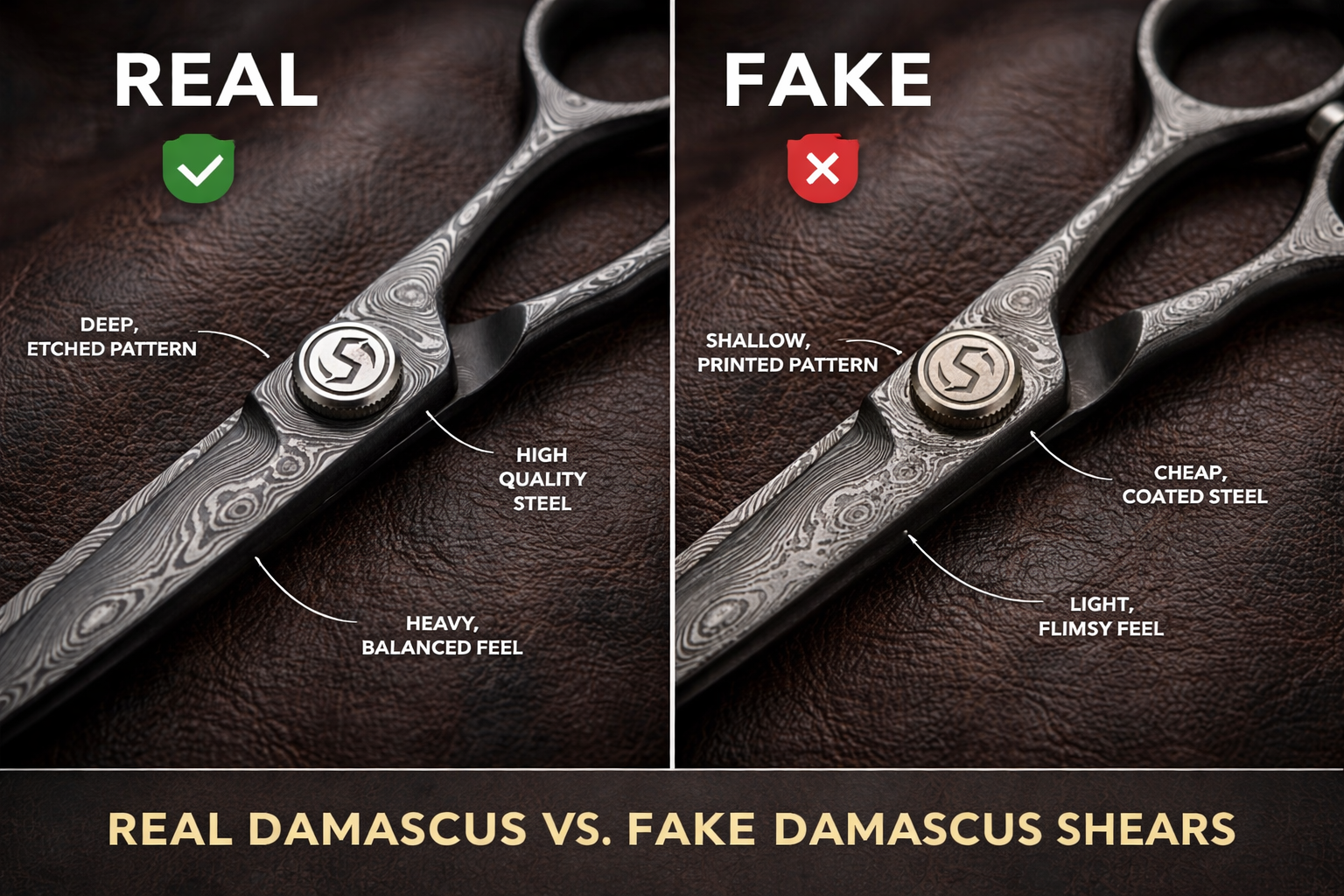
The popularity of Damascus shears has brought a flood of imitations onto the market. For professional barbers, spotting genuine Damascus versus cheap copies isn’t just about looks—it directly impacts cutting efficiency, hand comfort, and client satisfaction. Spending hundreds on shears only to find they’re fake can be a costly mistake.
Understanding Real vs. Fake Damascus Shears
True Damascus shears are made by layering a hard core steel like VG10 or ATS-314 with softer outer layers, which provides the following:
- Core hardness (HRC 60–63) for excellent edge retention
- Softer outer layers (HRC 52–56) to absorb shocks and prevent chipping
- Long-lasting sharpness, smooth cutting, and durability
Authentic shears may have 67 to 300+ layers, depending on the manufacturer. Fakes mimic the wavy pattern but are usually uniform stainless steel with surface etching—good looks, poor performance.
Why Fake Damascus Shears Are Common
Real Damascus requires intensive labor: forging, layering, heat treatment, and polishing are costly. Counterfeit shears use cheaper steel with etched patterns, leading to the following:
- Quick wear and dulling
- Inconsistent cuts
- Hand fatigue due to imbalance
Professional barbers need to recognize these signs to avoid losing money and credibility.
How to Identify Fake Damascus Shears
1. Steel Composition
- Real: VG10 (HRC 60–61) or ATS-314 (HRC 62–63) core with softer layers
- Fake: Plain stainless steel (often 440C)
- Tip: Ask sellers for steel specs; reputable manufacturers provide this.
2. Layer Count and Blade Pattern
- Real: 67–300+ layers, subtle pattern variation visible in light
- Fake: Flat, uniform, superficial etching
- Check edges and spine: slight inconsistencies indicate hand forging.
3. Blade Feel and Cut
- Real: Smooth, precise cuts with minimal hand fatigue
- Fake: Snags, folds, or pulls hair; less control
4. Craftsmanship
- Real: Subtle hammer marks, consistent tapering
- Fake: Overly symmetrical and machine-made
5. Price
- Real: $300–$700
- Fake: <$100
Practical Shop Checks
- Tilt blade under light to see depth in layers
- Flex blade lightly to test shock absorption
- Cut a small hair section to check smoothness
- Inspect pivot action for smooth, consistent motion
Visual Comparison
| Feature | Real | Fake |
| Core Steel | VG10, ATS-314 | Generic stainless |
| HRC (Core) | 60–63 | Unknown, often 55–57 |
| Layer Count | 67–300+ | 1 (etched) |
| Edge Retention | 900–1,100 cuts/day | 400–600 cuts |
| Blade Pattern | Deep, subtle waves | Uniform, superficial |
| Flexibility | Outer layers absorb shocks | Blade rigid or overly soft |
| Barbicide Safe | Yes | Yes, dulls quickly |
| Price | $300–$700 | <$100 |
Maintaining Genuine Damascus Shears
- Barbicide Safety: Quick soak (<10 min), rinse, dry, oil lightly
- Sharpening: VG10 cores last 900–1,100 cuts at 15 clients/day (8–10 weeks)
- Experienced Sharpening Only: Convex edges require skilled sharpening
- Cleaning: Remove hair and product after use
- Storage: Avoid loose bags or dropping them.
Who Should Read This Guide
- Barbers considering premium Damascus
- Owners of 440C or J2 looking for an upgrade
- Anyone researching $300–$700 shear purchases
Spotting fakes protects your investment, reduces hand fatigue, and ensures professional results.
Conclusion
Fake Damascus shears are common, but you can identify them by checking core steel, layer pattern, and price and performing hands-on tests. Investing in VG10 or ATS-314 Damascus ensures smoother cuts, longer edge retention, and less strain. Always verify steel specifications, layer count, HRC, and the manufacturer’s credibility. If a deal seems too good to be true, it probably is. With careful attention, you can confidently select genuine Damascus shears to elevate your craft.
FAQ
Are fake Damascus shears bad?
Not necessarily. Some use good steel and perform well. The issue is that the Damascus pattern is purely cosmetic.
How can you tell if Damascus is real?
Real patterns run through the blade and don’t fade. If the seller can’t explain the steel or process, it’s likely fake.
Do fake Damascus shears damage hair?
They can—but due to poor steel or grinding, not the pattern itself.
What’s better than Damascus shears?
For most barbers, 440C or VG10 shears offer better value and consistent performance.
Leave a Reply